
Protein: how much per day, really?
0.8, 1.6 or 2.2 g/kg? Your real protein needs by profile and goal, how to spread them, the best sources and the kidney-danger myth. Evidence-based.
Key takeaways
- The bare minimum (~0.8 g/kg) is far from optimal as soon as you're active or have a goal.
- To gain muscle or lose fat while keeping it: aim for 1.6 to 2.2 g/kg of bodyweight.
- Protein is the most satiating macro: it helps you hold a deficit.
- In a healthy person, high protein doesn't harm the kidneys (a stubborn myth).
It's probably the most asked nutrition question, and the one with the most contradictory numbers. The truth: there isn't a single “right” protein intake, but a range that depends on your activity and goal. And the gap between the official minimum and the optimum for body composition is huge. Let's sort it out, numbers in hand.
Why protein matters so much
Protein is the body's building material: muscles, skin, hair, enzymes, hormones, antibodies. Beyond structure, it has three decisive advantages when tracking your diet: it preserves (or builds) muscle, it's the most satiating of the three macros (very useful in a deficit), and it has the highest thermic effect (the body burns more energy digesting it). That's why it's priority number one in almost every goal.
How much to aim for by profile
The minimum recommended by authorities (around 0.8 g/kg, ANSES) covers basic needs to avoid deficiency, but it's designed to prevent deficiency, not to optimise body composition. As soon as you exercise or aim to lose fat or build muscle, the data point to clearly higher intakes (Phillips & Van Loon, 2011; Morton et al., 2018).
| Profile | Intake | Example (70 kg) |
|---|---|---|
| Sedentary | 0.8–1.0 g/kg | ~56–70 g |
| Active / recreational | 1.2–1.6 g/kg | ~84–112 g |
| Muscle gain / cutting | 1.6–2.2 g/kg | ~112–154 g |
| Advanced cut (very lean) | up to 2.4 g/kg | ~168 g |
Which weight to calculate on?
With significant excess weight, calculate on a “target” weight or lean mass instead, otherwise the total climbs needlessly. For most people, current bodyweight is a fine reference.
Should you spread it over the day?
The daily total matters far more than timing. That said, spreading protein over 3 to 4 servings of roughly 20 to 40 g each seems to slightly optimise muscle building versus one large dose (Schoenfeld & Aragon, 2018). In practice: hit your total, and try to have a protein source at each meal. No need to time it or obsess over a strict “anabolic window.”
The best sources
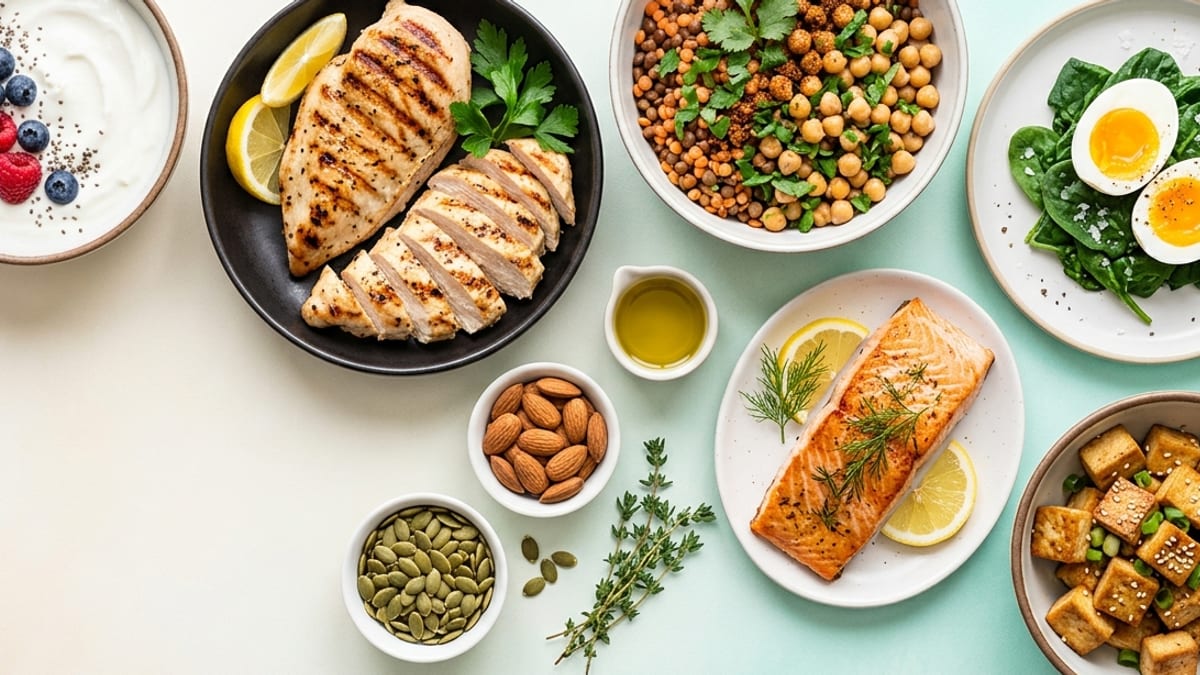
Animal proteins (eggs, meat, fish, dairy) are “complete”: they contain all essential amino acids in good proportions. Plant proteins (legumes, tofu/soy, whole grains) are excellent sources but some are lower in certain amino acids: simply varying them (e.g. legumes + grains) covers your needs. Soy and quinoa are complete plant proteins. Powders (whey, pea protein) are a convenient way to reach your total, not a requirement.
Is too much protein dangerous?
It's the most persistent myth. In people with healthy kidneys, high protein intake doesn't impair kidney function: a controlled study (Devries et al., 2018) found no harmful effect on the kidneys. The caution applies only to people who already have kidney disease, who should follow medical advice. For everyone else, aiming for 1.6–2.2 g/kg is safe. Just drink enough water.
The simple rule
A protein source at every meal, and a total around 1.6–2.2 g/kg if you have a body-composition goal. The rest (timing, powders) is secondary.
The real challenge isn't knowing your protein target, but knowing whether you actually hit it. Tracking your intake meal after meal (calories AND protein) is the most reliable way to go from “I think I eat enough” to “I do eat enough.”
Frequently asked questions
Can you absorb more than 30 g of protein per meal?
Yes. The idea of a strict per-meal cap is outdated: the body uses the protein, just a bit more slowly. Spreading is slightly preferable, but a large dose isn't “wasted.”
Are protein powders necessary?
No, they're just a convenient, affordable food to reach your total. You can cover everything with whole foods if you prefer.
Can a vegetarian get enough protein?
Absolutely, by varying sources (legumes, soy, whole grains, plus eggs and dairy for vegetarians). You sometimes aim a bit higher and pay attention to amino-acid variety.
Does too much protein make you gain weight?
Protein provides calories (4 kcal/g): an overall calorie surplus causes weight gain, whatever the source. But at equal calories, protein is the most satiating and the most muscle-friendly.
Scientific sources
- 1.Morton RW, et al. Protein supplementation and resistance training: a meta-analysis. Br J Sports Med. 2018.
- 2.Phillips SM, Van Loon LJ. Dietary protein for athletes: from requirements to optimum adaptation. J Sports Sci. 2011.
- 3.Devries MC, et al. Changes in Kidney Function with Higher- vs Lower-Protein Diets in healthy adults. J Nutr. 2018.
- 4.Schoenfeld BJ, Aragon AA. How much protein can the body use in a single meal? J Int Soc Sports Nutr. 2018.
- 5.ANSES. Les protéines (références nutritionnelles).
Track your nutrition the easy way
DIAT scans your meals and computes your calories, macros and 27 micronutrients. Staying in a deficit gets simple.
Get started free