
How to track your calories and macros (without it taking over your life)
The simple method to track calories and macros, why it really works, how long to do it, and how scanning speeds everything up. Evidence-based.
Key takeaways
- Tracking calories = becoming aware of what you really eat. It's the number-one steering tool.
- Regular self-monitoring is linked to better weight-loss results (Burke et al., 2011).
- Method: set your goal → log your meals → hit your numbers → adjust on the trend.
- Scanning / photographing a meal removes the chore of manual entry.
Tracking calories has a bad reputation: people picture it as tedious, obsessive, reserved for bodybuilders. The reality is simpler. It's just the most reliable way to know what you actually eat, and it's often a revelation. Done well, it takes a few minutes a day and quickly becomes second nature. Here's the method.
Why it really works
Most people greatly underestimate what they eat, sometimes by several hundred calories a day. Tracking breaks this illusion: you finally see the real quantities, the hidden calories (oils, drinks, snacks), and you can act on them. It's no coincidence that weight-loss research shows regular food tracking is one of the best predictors of success (Burke et al., 2011; Hollis et al., 2008). What you measure, you improve.
The method in practice
- Set your goal. Calories (from your TDEE and aim) and protein (1.6–2.2 g/kg). That's your daily target.
- Log everything you eat, as you go (more reliable than recording it all in the evening).
- Be honest about quantities: weigh or estimate as accurately as possible, especially calorie-dense foods.
- Watch the trend, not a single day: adjust your calories after 2–3 weeks based on your weight change.
How long should you track?
Good news: not necessarily for life. Tracking for a few weeks to a few months is often enough to recalibrate your perception: you learn portions, the calorie density of foods, and you build references you then keep naturally. Some track continuously because they like the precision; others do it in “cycles” (during a cut, then ease off). Both work. The goal isn't to become a slave to an app, but to gain autonomy.
The shortcut that changes everything
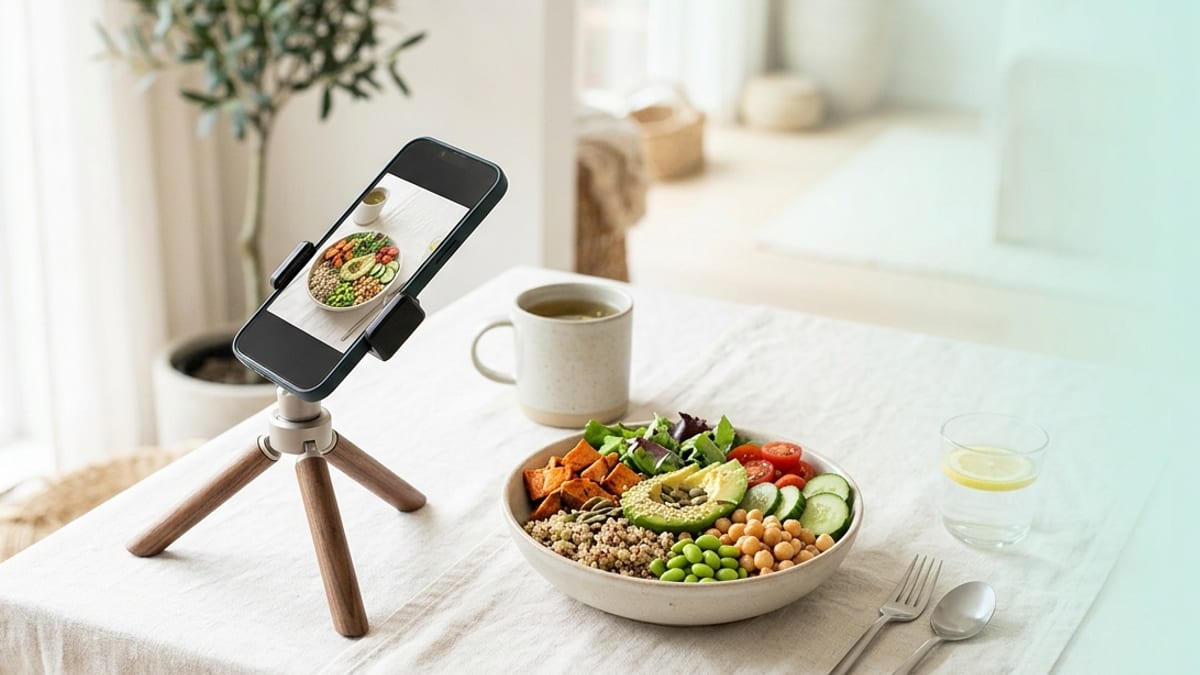
Manual entry is what discourages people most. Scanning a dish or a barcode, or photographing your meal, removes that friction: it's the difference between lasting a week and lasting months.
Where DIAT saves you time
That's exactly the problem DIAT solves: instead of searching every food in a database and entering grams by hand, you scan your meal or a barcode, and the app estimates calories, macros and 27 micronutrients. You stay in control (you adjust quantities), but you remove 90 % of the chore. That's what makes tracking sustainable day to day, and therefore effective.
Tracking isn't an end in itself: it's a learning process. After a few weeks, you'll instinctively know what's on your plate, and you'll be able to decide with full awareness.
Frequently asked questions
Does counting calories make you obsessive?
For most people, no: it's a neutral awareness tool. With a history of disordered eating, it's better to avoid strict counting and seek support.
Should you track on weekends too?
Ideally yes, because that's often where the balance slips. Many eat “well” during the week and undo it all on weekends without realising.
What if I eat out?
Estimate as best you can from a similar dish in the database, or scan/photograph the plate. Regular approximation beats giving up: the point is to keep a ballpark.
Scientific sources
Track your nutrition the easy way
DIAT scans your meals and computes your calories, macros and 27 micronutrients. Staying in a deficit gets simple.
Get started free