
Weigh or scan your food? Accuracy in practice
Should you weigh everything to the gram or is scanning enough? The real accuracy you need, portion cues and when the scale truly matters. Evidence-based.
Key takeaways
- Weighing is the most accurate method, but the most constraining day to day.
- Scanning / photographing is less precise but far more sustainable: consistency beats absolute precision.
- “By eye” estimates are often wrong: hand-based cues help a lot.
- Accuracy matters most for calorie-dense foods (oil, butter, sauces, nuts).
As soon as you start tracking, one question comes up: do you need to pull out the scale at every meal, or is a scan / estimate enough? The pragmatic answer: it depends on the food and your goal. And above all, the perfect method you drop after a week is worth less than the imperfect one you keep for months.
Weighing: precise but demanding
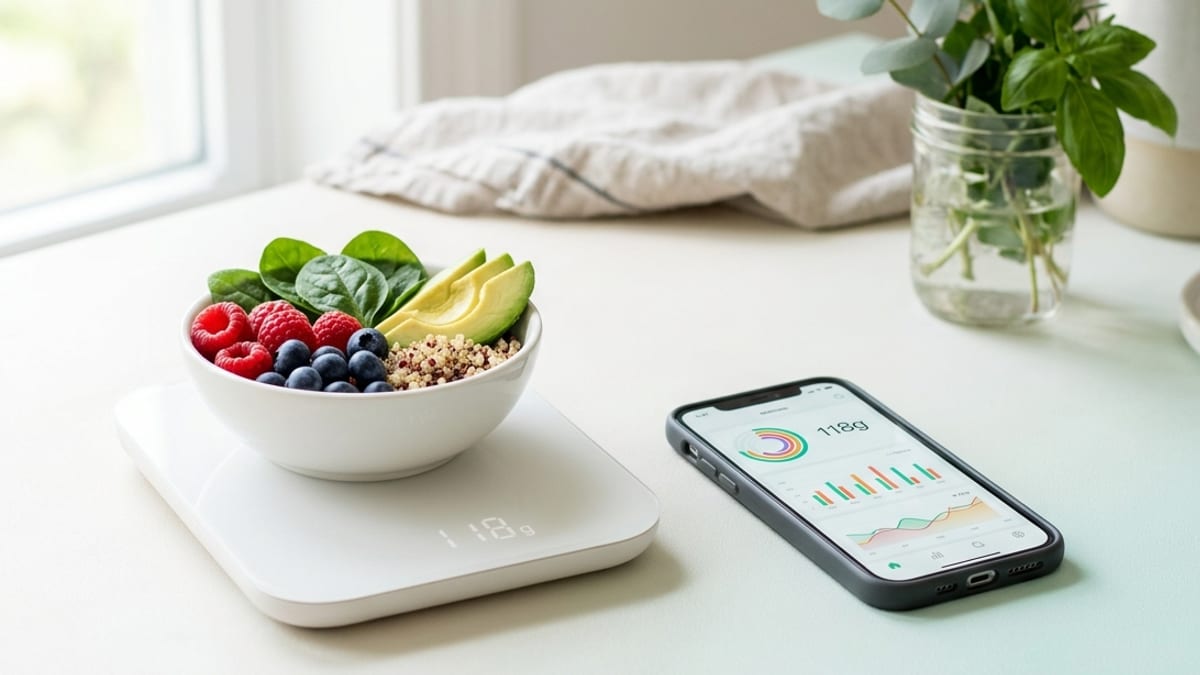
Weighing food on a kitchen scale is the most accurate way to know quantities, hence calories and macros. It's the reference method, ideal during a serious cut or when you really want to understand portions. Its downside: it's constraining, impractical at restaurants or on the go, and it can become a burden. Many tire of it and quit entirely, which is the worst scenario.
Scanning and photos: sustainable day to day
Scanning a barcode or photographing your meal gives a slightly less precise estimate than weighing, but more than enough to steer your diet, and above all much faster. Research on food tracking is clear: what predicts results is the consistency of tracking, not its perfection (people who track often do better, even with estimates). A fast method you use every day beats a perfect one you abandon.
Why “by eye” estimates miss
Studies show humans estimate portions poorly and often under-report intake (Livingstone & Black, 2003). A tool, even an approximate one, corrects this bias far better than intuition alone.
Estimating a portion without a scale
When you can't weigh, visual cues with your hand help: a palm = roughly a protein portion (~100–120 g), a fist = a vegetable portion, a cupped hand = a carb portion (cooked), a thumb = a fat portion (~1 tbsp). These aren't exact, but they're guardrails that prevent big misses.
When accuracy really matters
Not all foods deserve the same rigour. For leafy greens (very low-calorie), approximation is harmless. But for calorie-dense foods, a small quantity error weighs heavily: oil, butter, sauces, nuts and cheese can add hundreds of invisible calories. There, the scale (or at least a careful spoon measure) makes a real difference. Focus your accuracy on these foods.
The smart strategy
Scan or estimate the bulk of the meal for speed, and precisely weigh the tricky foods (oils, butter, cheese). You keep sustainability AND accuracy where it matters.
The goal isn't accounting perfection, it's tracking accurate enough, regular enough to move you forward. A fast scanning tool keeps you from quitting; targeted weighing of dense foods gives you the useful accuracy. The best of both worlds.
Frequently asked questions
Should you weigh raw or cooked?
Ideally raw, because database values are often for the raw food, and cooking changes weight (water). If you weigh cooked, pick the matching “cooked” entry.
Is photo scanning reliable?
It gives a good estimate for most dishes and saves valuable time. For very calorie-dense foods or ambiguous mixed dishes, check and adjust the suggested quantity.
Should I buy a kitchen scale?
It's a small, very useful investment, at least at first, to learn portions and weigh dense foods. Then you can switch mostly to scanning and keep the scale for the tricky items.
Scientific sources
Track your nutrition the easy way
DIAT scans your meals and computes your calories, macros and 27 micronutrients. Staying in a deficit gets simple.
Get started free